


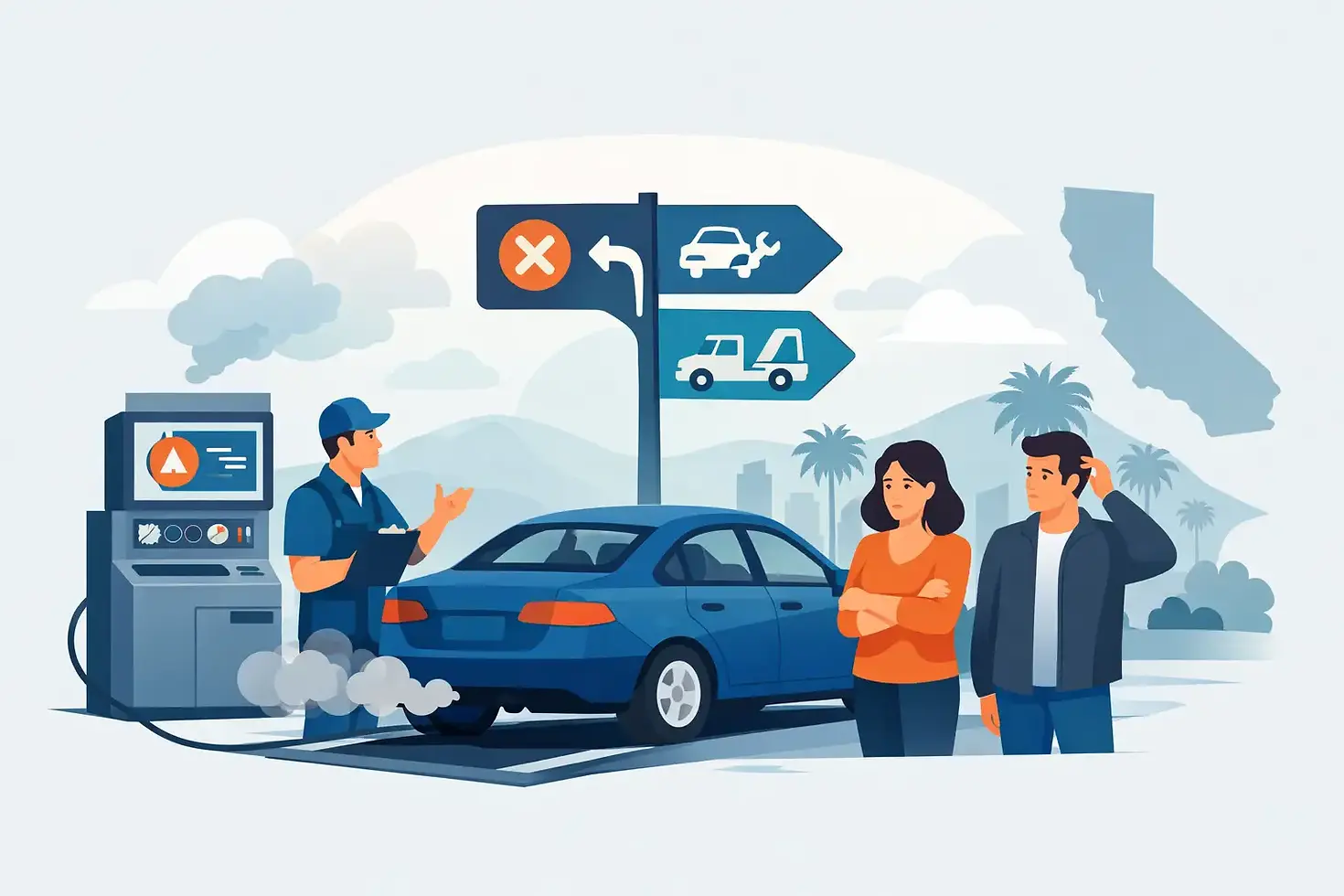
Failed Smog Retest Options in California
That second failed result can feel worse than the first. If you are looking for failed smog retest options, the main thing to know is that California gives you a few possible paths forward, but the right one depends on why the vehicle failed, what repairs have already been done, and whether you are dealing with a simple monitor issue or a true emissions problem.
For most drivers, the mistake is treating every smog failure the same. A car that fails for high emissions, a check engine light, or incomplete readiness monitors is not in the same situation. The paperwork may look similar, but the next step is different in each case. Taking the wrong step can waste time, money, and another trip to the test station.
Failed smog retest options depend on the failure reason
Start with the Vehicle Inspection Report. That report tells you whether the problem is tailpipe emissions, an illuminated malfunction indicator light, OBD communication issues, or monitors that are not ready. It may also show functional failures tied to the emissions system.
If the vehicle failed because the check engine light is on, a retest without repairs usually does not make sense. The system has already detected a fault, and the car will generally fail again until the underlying problem is fixed and the vehicle completes the required drive cycle.
If the vehicle failed because readiness monitors were incomplete, the issue may be timing rather than a bad part. This often happens after the battery was disconnected, codes were cleared, or recent repairs reset the system. In that case, the retest option is usually to drive the vehicle under normal conditions until the monitors set. The catch is that not every monitor completes quickly. Some need specific speeds, temperatures, fuel levels, or stop-and-go patterns.
If the vehicle failed for high emissions, you are usually looking at a repair decision. That could be a sensor, evaporative system component, catalytic converter issue, vacuum leak, fuel trim problem, or another emissions-related fault. A retest before diagnosis is mostly a guess.
What to do after a second smog failure
A second failure does not automatically mean the car is finished or that registration is impossible. It does mean you need to be more deliberate.
The first step is to compare both test results. If the failure reason changed, that matters. For example, a car may first fail for a stored trouble code, then fail the retest because monitors are incomplete after the repair shop cleared codes. That is frustrating, but it is not the same as repeated emissions failure. It may mean the repair was performed, but the vehicle was brought back too soon.
If the same failure appears again, ask for a repair explanation in plain language. You want to know what was replaced, what was tested, and why the original fault is still present. Good repair work on emissions problems is diagnosis first, parts second.
You should also keep every receipt and diagnostic record. In California, documentation can matter if you later need to show repair history or explore financial assistance or waiver-related options through the state.
Your practical failed smog retest options
For most California drivers, there are four realistic routes.
The first is further diagnosis and repair. This is the most common path when a vehicle has an active emissions fault. If the prior repair did not solve the issue, the next shop should not just replace more parts at random. They should confirm whether the original diagnosis was correct, whether a new issue is present, or whether the repair was incomplete.
The second is completing the proper drive cycle when monitors are not ready. This is common after battery replacement, code clearing, or emissions work. A lot of vehicles need a mix of freeway driving, city driving, cold starts, and rest periods before the system reports ready. There is no universal mileage number. One car may set quickly, while another may take several days.
The third is looking into California consumer assistance programs if repair costs are becoming too high. Depending on eligibility, some motorists may qualify for state help with emissions-related repairs or vehicle retirement options. This is not available in every situation, and eligibility rules apply, but it can be worth checking before continuing to spend money on an older vehicle with repeated failures.
The fourth is considering whether a waiver or comparable state relief path may apply. In California, these situations are specific and controlled by state rules. They are not automatic, and they usually require documented emissions-related repair spending at the appropriate type of facility. Many drivers assume a failed retest alone qualifies them. It does not. The details matter.
When a waiver might be possible
This is the area where many people get bad advice. A waiver is not a general escape from smog requirements. It is a limited option tied to state criteria.
In California, waiver-type relief usually depends on factors such as whether the vehicle failed a required smog inspection, whether qualifying repairs were attempted, how much was spent, and whether the work was done in a way the state recognizes for the program. The exact requirements can change, so drivers should confirm the current rules before relying on this path.
The practical point is simple. If you think you may need a waiver, do not guess. Save receipts, ask whether the repair facility documentation is sufficient, and verify the current BAR process before authorizing more work. The order matters. Spending money in the wrong place or without proper records can leave you with the bill and no relief.
How to avoid wasting money on another failed retest
A retest should happen for a reason, not just because a few days passed.
If the check engine light was the original issue, confirm the light is off and the underlying codes have been properly addressed. If codes were cleared, confirm that the required monitors have had time to reset. If a shop says the vehicle is ready, ask whether they verified monitor status with a scan tool.
If the car had emissions-related repairs, make sure the repair shop road-tested it and confirmed the correction. This is especially important when the problem involved intermittent faults, evaporative leaks, or catalyst efficiency codes that can return after a short period.
Fuel level also matters on some vehicles, especially for evaporative system monitor completion. So does battery condition. A weak battery can interrupt monitor readiness and create confusion during the retest process.
It also helps to test at an official California test-only center when that is what your situation calls for. A licensed station that focuses on inspection and certification can give you a clear result based on state procedure, without blurring the line between testing and repair.
Common situations drivers run into
One common case is the car that runs fine but still fails. That usually points to an emissions control fault that is not obvious in day-to-day driving. Modern vehicles can feel normal even when a sensor, purge valve, catalyst, or software-related issue is affecting emissions compliance.
Another common case is the vehicle that had repairs done right before the retest and then failed again. Often that is a monitor problem, not proof that the repair failed. If the codes were cleared, the system may simply not be ready yet.
Then there is the older vehicle with rising repair estimates. That is where failed smog retest options become less about passing the next test and more about making a practical decision. If the car needs major emissions work and has other age-related issues, it may be time to compare repair costs with the vehicle's value and expected remaining life.
Commercial vehicles, RVs, and larger trucks add another layer. These vehicles may have more complicated emissions systems, higher repair costs, and tighter scheduling needs because downtime affects work. In those cases, documentation and a clear plan matter even more.
Before you schedule the next test
Take a breath and verify three things. First, you know the exact reason the vehicle failed. Second, you know what changed since the last inspection, whether that was a repair, a code reset, or additional driving. Third, you have records of what has been done so far.
If you need a retest, use a station that is licensed, experienced, and familiar with a wide range of California vehicle types. For East Bay drivers, that practical, test-only approach is why many customers choose stations like Time 4 Smog Check when they need a straightforward inspection result without confusion.
A failed retest is not a dead end. It is usually a sign that the next step needs to be more precise than the last one.


Comments